
Grade Your Church’s Online Presence in 20 Minutes
Most congregations have no real idea whether their online presence is working. Not because anyone is careless, but because nobody has ever sat down and checked. And vague uncertainty is paralyzing, because it’s hard to fix a problem you can’t name.
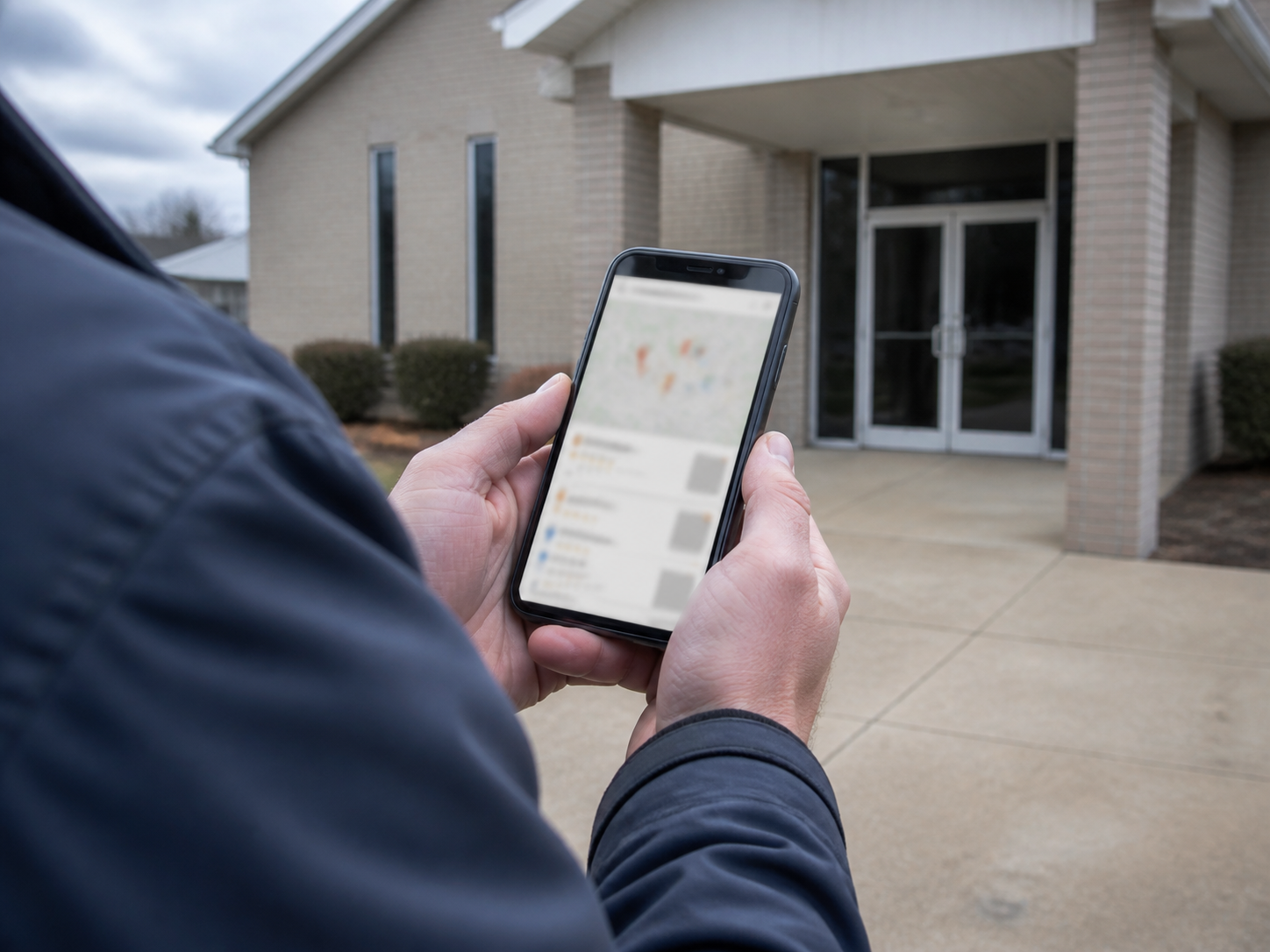
Most congregations have no real idea whether their online presence is working. Not because anyone is careless, but because nobody has ever sat down and checked. And vague uncertainty is paralyzing, because it’s hard to fix a problem you can’t name.
So here’s a self-audit you can run yourself, in one sitting, without buying anything or calling anybody. Five parts, twenty minutes, and a plain score at the end.
One instruction before you start, and it matters more than any of the questions. Do this on your phone, not a computer, and do it as a stranger would. Most searching people are on a phone, and what looks fine on a desktop is frequently a mess on a small screen. If you can, ask someone who doesn’t attend to sit with you and tell you honestly what they see.
Give yourself one point for each yes.
Part One: Can They Find You at All?
Search your church’s name plus your town, the way an outsider would type it.
- Does your congregation come up in the first few results?
- Now search something more general, like “church of Christ near me” or “churches in [your town].” Do you appear anywhere?
- Is there a listing for your congregation with your correct address, hours, and phone number?
- Does that listing have real photos, not just a street view of the building?
What this measures: whether a person who doesn’t already know your name can locate you. Missing points here are the most urgent kind, because everything else you do points back to a place people can’t reach.
Part Two: Is Your Information Right?
Check every place your church appears, including your own site, your listings, and any social pages.
- Are your service times correct and identical everywhere they appear?
- Is your address correct everywhere, and does the map pin actually land on your building?
- Do all your links work when you tap them?
- Is there a phone number or email that a real person actually monitors?
What this measures: whether you’re trustworthy at a glance. Conflicting or wrong information does real damage, and this is the cheapest thing on the whole list to fix. Wrong service times have sent visitors to a locked building, and most of them never try again.
Part Three: What Does a Stranger Actually See?
Open your website on your phone and look at it as someone who has never attended anywhere.
- Within a few seconds, can you tell when and where the congregation meets?
- Does the site say anything about Jesus and the Gospel, rather than only listing schedules and events?
- Are there photos of actual members, recent ones, rather than only the building or stock images?
- Is there anything that answers a nervous first-time visitor’s questions, like what a service is like, what people wear, or whether they’ll be singled out?
- Does anything on the site show recent life, so it’s clear the congregation is still active?
- Is there a clear, unpressured way to plan a visit or ask a question?
What this measures: whether a searching person can picture themselves walking in. This is where most congregations lose the most points, because their site was quietly built for the members who already attend.
Part Four: What Happens When Someone Reaches Out?
This one requires a small experiment, and it’s the most revealing part of the audit.
- Send a message through your own contact form, and a message to your social page, as though you were a stranger with a question.
- Did a real person respond within a day?
- Was the response warm and personal, rather than a form reply?
- Does one specific person in your congregation know it’s their job to watch for these?
What this measures: whether the courage it took someone to reach out gets rewarded. This is the highest-value section on the list, because a soul who reached out and got silence is a soul you had and lost. If you score zero here, stop the audit and fix this first.
Part Five: Is Any Teaching Getting Out?
- In the past month, has your congregation published anything, a clip, a written piece, anything, that a person outside your membership might encounter?
- Is any of it aimed at an outsider’s real question, rather than being an announcement for members?
- Are your sermons available somewhere a stranger could actually find and listen to them?
- Is there anything in writing that explains what you believe in plain language an outsider could follow?
What this measures: whether your congregation’s faithful teaching is reaching past the walls or evaporating every Sunday afternoon.
Read Your Score
Add it up. Twenty-two possible.
Eighteen to twenty-two. You’re in genuinely good shape and ahead of most congregations. Now, your work is consistency, keeping it current and continuing to publish. Look at your lowest section and strengthen it.
Twelve to seventeen. The foundation is there and something specific is broken. Look at which section cost you the most points, because that’s your answer, and it’s usually a fixable one.
Six to eleven. A searching person can probably find you but likely won’t be moved to act. Most congregations in this range have a site built for members and no real path for a stranger. Start with parts two and four.
Zero to five. You are effectively invisible to your community, and the good news is that the first several points are the easiest to earn in the whole list. Fix your listings and your information this month. That alone will change your score substantially.
What to Fix First, Whatever Your Score
The order matters, because congregations often start with the hardest thing and stall.
Fix wrong information first. It costs nothing but an afternoon, it prevents real harm, and it’s entirely within your control.
Then make sure somebody answers. Name the person, tell them it’s theirs, and agree on how fast. Also free.
Then make your site speak to a stranger. This is a bigger lift, but it’s the difference between a brochure and a tool.
Then start publishing something, however small, at whatever pace you can genuinely sustain.
Notice that the first two cost nothing at all, and together they probably represent your largest gain. Any congregation can do them this month.
Run It Again in Six Months
Write your score down somewhere with today’s date. Then run this again in half a year, and you’ll have something most congregations never get, which is an honest picture of whether you’re improving.
And if you’d like a second set of eyes on it, or an honest read on what your lowest section would actually take to fix, we’re glad to look with you.
At Project Go, we help churches of Christ find and close the gaps between their congregation and the people searching in their community. Book a call.
Know Your Score. Now Close the Gap.
Project Go helps Churches of Christ find and fix exactly what’s costing them the most points, whatever section came up short.
Book a Free Discovery Call