
What Your Tract Rack Understood
There’s a rack in the back of a lot of buildings, and it’s one of the most quietly evangelistic things a congregation owns.
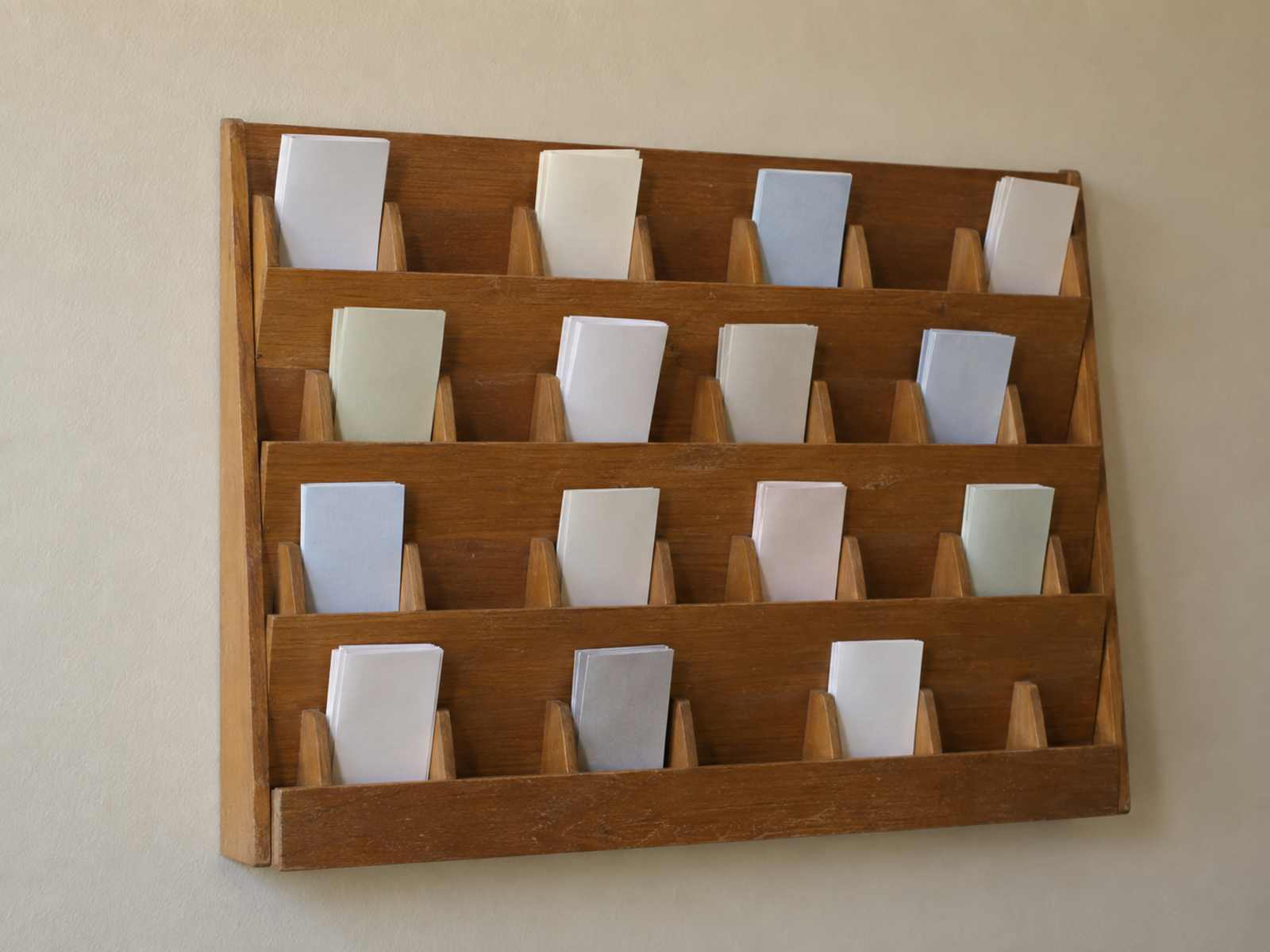
There’s a rack in the back of a lot of buildings, and it’s one of the most quietly evangelistic things a congregation owns.
Nobody thinks much about it. It’s been there for decades, somebody keeps it stocked, and most Sundays nobody touches it. But look at how it was designed, because whoever set up the first one understood something that most church websites still don’t.
What the Rack Gets Right
Take it apart piece by piece.
- Each one answers a single question. Not a survey of everything a person might ever need to know. One question, addressed in full. What must I do to be saved? Why do we sing the way we do? What happens after death? Somebody walks up with a question and finds a piece written specifically for it.
- It’s written for an outsider. Good tracts don’t assume you grew up hearing any of this. They define terms. They start from the beginning. They’re written in plain language because they were made for someone who may not have the vocabulary yet.
- It’s free and there’s no obligation. Nothing is asked. No name, no address, no conversation. You take it and go.
- You don’t have to talk to anybody. This is the part churches most underestimate. A person can stand at that rack, find what they need, and leave without ever admitting to a single soul that they had a question. The privacy is the feature.
- It’s self-serve and always available. It doesn’t need the preacher standing there. It works on a Wednesday, after everyone’s gone, whenever somebody happens to be ready.
That’s a genuinely good piece of thinking, and it’s decades old.
Almost No Church Website Works That Way
Now hold that up against how most congregations build a site.
Instead of one question per page, you get a single About page trying to cover everything at once. Instead of writing for an outsider, the language assumes a person already knows the terms. Instead of no obligation, the only way to engage is a contact form that asks for a name and an explanation. Instead of privacy, every path leads to talking to someone. And instead of a rack full of answers, there’s a schedule and a calendar.
We’re not saying that to be hard on anyone. It’s just what happens when a site gets built around what the congregation needs rather than around what a searching person needs, which is the natural way for it to happen.
But notice the irony. A congregation that has faithfully kept a tract rack for forty years already believes in exactly the right model. It just never occurred to anyone that the website is the same shelf, reaching vastly more people.
Your Website Is a Rack That Never Runs Out
Here’s the comparison worth sitting with.
The rack in your building reaches people who are already inside it. That’s a small number, and most of them are members.
The same content published online reaches anyone in your county who types that question at midnight. It costs nothing to keep stocked. It’s never picked over. It doesn’t require someone to walk into a building first, which is precisely the barrier most searching people can’t get past yet.
Everything the rack does well, a website can do at a scale the rack never could. And the churches that already understand why the rack matters are the ones best positioned to do this, because they don’t have to be convinced of the principle. They’ve been practicing it for years.
What This Looks Like in Practice
Take the model literally.
Write one page per question rather than one page covering everything. Pick the real questions people ask, including the ones your tracts already cover, and give each its own plain answer.
Write them for someone with no background. Same discipline the tracts use. Define the terms, start at the beginning, keep it plain.
Ask nothing in return. Let a person read the whole thing without a form, a signup, or a wall.
Make it possible to get everything they need without talking to anyone. Then offer a conversation as an option, warmly, without requiring it.
And keep it stocked. A rack with three faded pamphlets doesn’t serve anyone, and neither does a site with one page written in 2019.
The Conviction Was Already There
This is what we find encouraging about the whole comparison.
We’re not asking congregations to adopt a new conviction about evangelism. The conviction is already in the building, mounted on the wall, quietly doing its work.
Somebody decades ago believed that a searching person deserved a plain answer, written for them, free, available without having to ask. That was right then and it’s right now.
The only thing that’s changed is where the person stands when they go looking. They used to have to be in your building. Now they’re on their phone, and the rack can reach them there.
Same shelf. Much longer reach.
At Project Go, we build church websites and stock it with content that answers real questions for real searchers. If you’d like help stocking the shelf, book a call.
Want Help Stocking the Shelf?
Let’s build the pages that answer the questions your community is already typing — one question, one plain answer at a time.
Book a Free Discovery Call